# Mission: build a Guitar
Table of Contents
For the next two weeks, I’ll be in a luthier’s workshop, building a guitar. It’s actually the second solid body electric guitar I’ll have started to build, but I am hoping for more success in completing this one.
The last one
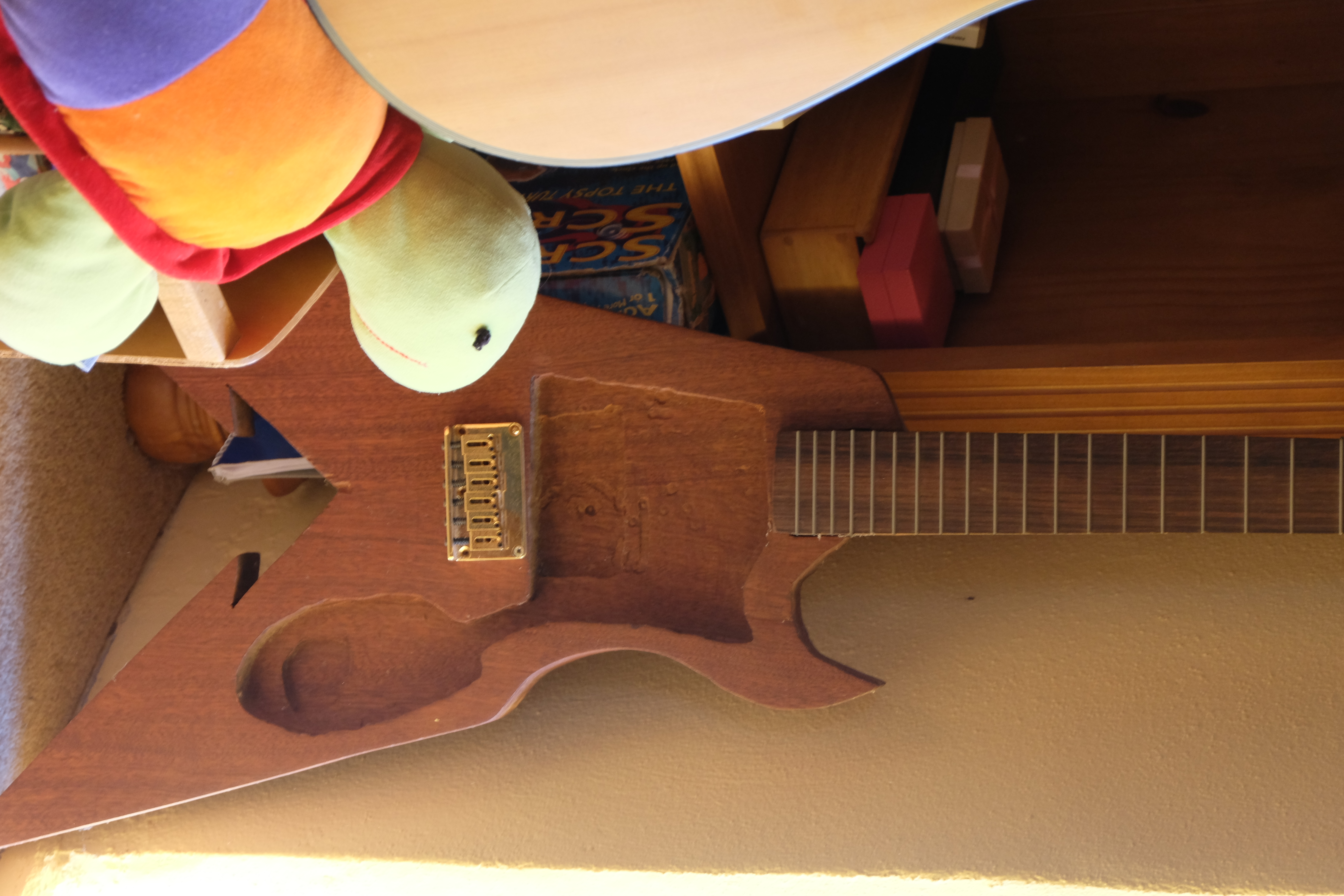
When I was 15 or so, I was enrolled in woodworking class at school. We were tasked with coming up with a substantial self directed project, and like any 15 year old Brian May fan, I was aware that he (and his engineer father) had built the Red Special, the guitar he went on to play over the course of his 50 year long career.1
Naturally, I wanted to follow in his footsteps, and build my own guitar. My father, however, was not going to spend hours in a workshop with me2, and I had this big project requirement at school, so I began doing my research into scale lengths and parts sourcing, and broke out my actual honest to god physical drawing board and technical kit, and set about drafting a 1:1 scale model of the guitar.
I was into various rock bands at that time. I think I still liked the idea of playing Gibson style guitars, and while I wasn’t a big Zakk Wylde fan (he has gone on to have several signature guitars with a similar body type), I loved Jack Black’s SG from School of Rock, and the white Flying V also from School of Rock.
I must’ve taken these plans in to my woodworking teacher, who we called “Hack”, who told me that it was an ambitious project, but it would certainly fit the requirements for that particular assignment.
I don’t remember much of the construction - only that as I was still in the first part of secondary school, I wasn’t allowed to use the “serious” power tools that were in the other room. I was let loose on the drill press, the various sanders, the band saw (I’m pretty sure), and unbelievably, the router. This meant that milling operations were left to my teacher.
There were some serious design flaws with the Guitar. Something I had not yet figured out in my research was how to retain the string balls in the body - the term “ferrule” had not shown up. I don’t believe I got to the stage of actually boring the through-holes for the strings.
I had chosen Mahogany for the body because the Red Special appears to be Mahogany. I think I realized that it was veneer on a bunch of engineered wood, but that seemed complicated, so I just went for a fully solid mahogany body, in a form much more massive than a Les Paul - this thing must weigh in at about 2 Telecasters.
I was let loose on the router with a little instruction - keeping the router pressed flush to the workpiece was important - but nobody ever mentioned templates. Not that I had access to them - this was a custom body design, and my school had focused on paper technical drawing (I swear I’m not 80 years old). I think we had an ancient 80s CNC in the metal shop, but there was simply no prospect of lasercutting templates from a CAD model. I don’t think I even knew that was possible. As a result, I have an extremely wonky looking cavity in the front of the body for the pickups and controls.3
The electronics were a compromise with the doubting adults - I needed to convince them that I could do it, so I talked about how much support I had with the woodworking, and de-scoped the Red Special style complex circuitry with the per-pickup phase inversion and onboard effects (which Brian May removed from his guitar after consulting with Rory Gallagher on the uses of the volume knob). I was going to put a single humbucker in the bridge position, and a single volume pot. I could come back to the fancy stuff later, and the adults were convinced that a 3 component circuit was achievable.
I spent hours with a spokeshave hand-carving the neck. I was very nervous that I would cut through to the truss rod and wreck the whole thing, so it’s an extremely chunky neck. I believe the fretboard was ordered from StewMac, neither I nor my woodworking teacher fancied hand-slotting it. I didn’t even entertain the possibility of inlays - I remember being absolutely unable to understand how anyone could possibly do them. The frets lifted out of the slots, I guess I didn’t think about glueing them in.
The real death bell for this guitar was the neck pocket. I was nervous about cutting it, I didn’t think I could achieve the snug fit that was required, so I asked for help with it. I can’t say for sure what happened or whose fault it was, I genuinely don’t trust my memory and therefore don’t want to cast blame, but ultimately that joint was too loose, and that kind of repair is definitely something I wasn’t capable of. So this is where I called it. It was enough to pass my assignment (I think I actually did quite well on it), I assume it was because the wood part was mostly done, actually stringing it up wasn’t a requirement, and I had done a lot in the design phase.
It’s still hanging out at my parents place, which is an extremely old and extremely humid house. This “guitar” doesn’t have any finish on, so it’s just been exposed to moisture for a couple of decades. I would vaguely like to pick it up and finish it, but there are so many issues with it. Even if I can get the neck pocket fixed, it’s going to be an extremely heavy guitar. Maybe one day!
The back burner years
There were several reasons, both academic and related to my family circumstances that meant I couldn’t really continue building guitars for the next couple of years. After an international move, my new school focused mainly on the kind of academics that the wealthy expatriate community appreciated, and got them into fancy universities. Woodshop was off the menu. I spent a couple of years digging into philosophy, post-dramatic theater, and “information technology in a global society” (sheesh, that worked out great). At university, I did build a guitar neck shaped midi controller in a 3d printed casing, but that was the extent of my luthier work. I don’t think I worked wood (😏) for about a decade.
After wasting my 20s working 18 hour days for tech companies that I cared about, who turned out to primarily be interested in doing bad things for profit and just because they can, I was able to buy a house. My partner and I both work in tech, and both had maker goals that were hampered by being in a city apartment. So we’ve ended up in a rural house with a basement, and I got to work getting back into woodworking. I’ve done a few small projects:
- a low workbench
- a stool
- a shelf for the kitchen
- another different stool
- a nice beech mallet
- halfway through a full workbench
- “brooms” to help us lift and hold ceiling panels when we redid some ceilings
I’m certainly not building fine furniture, and my throughput is not very significant, but I’m getting back into the hobby, learning new skills, reigniting old ones, rebuilding my knowledge, and correcting bad habits. And sharpening, never ending sharpening, it’s the secret hidden hobby in the hobby.
I had been aware of a luthier near the city I lived in who runs courses, but I am one of those weirdos who has not yet been convinced that catching covid twice a year is a good plan, and so I didn’t even entertain the possibility of enrolling.
Someone in a woodworking discord I am in posted their build, and recommended the course, and I decided that life’s too short to never do this. I can wear a mask and probably not get too many weird comments.
The next one
I’m planning something quite different to the original guitar. I’m not ambitious enough to try and take on an entire Red Special build in the course of 2 weeks, the glue ups in constructing the engineered wood alone probably put me out of that time frame. My guitar collection has grown over the years, and so I ought to build something unlike what I’ve already got. I’ve developed a bit of a distaste for Gibson4, so the inspirations for the first one are kind of out (though I’ll always like an SG, and I don’t have one).
I’m going for an J style with two P-90s. I got to play Michael Dales’ Älgen5 at EMF last year, and loved the sound, so I’m giving them a try. I’m going for a chestnut body, as it’s a non-endangered European hardwood. The J style trem may be achievable, but I can also always de-scope and do a wraparound tailpiece behind the bridge, to make it easier to get it done in the time I have.
Some inspirations:
- Novo Voltur J
- On a trip recently I saw this carvetop Fender Jazzmaster
- This Justin Hawkins roasted maple + worn neon finish superstrat
- Bilt Guitars
The biggest unknown for me is finishing. Beyond some oil, I can’t remember finishing any wood project, and I know that a lot of painting requires layers and layers of application, drying, light sanding, and buffing. We’ll see how it goes!
The plan
I’m writing this on the Saturday before starting the course. I put this website together, bought a domain, set up a CDN, etc. I’m hoping I can set myself up for extremely easy posting from the workshop - even snapping a picture and immediately publishing it with a short caption. So, if this is of interest to you, I’d love it if you subscribed to [my rss feed]. I don’t yet really have a mechanism for you to message me, but if/when I do I’ll update here and on the feed.
I can’t wait to get started!
Footnotes
-
It’s got quite a community these days, with plenty of high end replicas available, as well as countless build videos, manufacturers of custom machined parts, wound pickups. It’s a project I’d like to get around to at some point, but I’ve got to finish something simple first. ↩
-
He did, however, walk into a rural wood store and ask for some somewhat exotic hardwoods from people who mainly dealt in construction lumber, for which I am grateful. ↩
-
At that point I hadn’t played many electric guitars, and though I had a book with thousands of pictures of various models that I would read again and again late into the night, I think my design was informed mainly by my familiarity with that one. That explains the through-body strat-esque hardtail bridge, and the idea of mounting the electronics to the scratchplate. ↩
-
Those prices are wild. I know there are economics, but I also know there’s an intentional “boutique brand” strategy. ↩
-
Watching Michael’s progress with his builds has been a huge inspiration for me in trying again. Thanks Michael! ↩
Got thoughts? Email me!
Comments
This blog supports webmentions.
No comments yet
More Posts
# Getting Started
A big block of sustainable European chestnut. It’ll be my guitar body.